Showing posts with label Effective. Show all posts

Friday, September 23, 2011

Indiana Gorilla and the Artifacts of Agile


"Okay and Eric, you were working on the shopping cart ordering story, right?"

Eric nodded, but remained silent.

"And tomorrow you should be done and moving on to the Wish List story, right?"

He nodded again, still silent. He was a good engineer, never spoke unless he really had something to say.

"Any impediments?"

Eric looked around the table at the other seated engineers. None of them met his gaze, intent on their own computers. Then he shrugged and turned back to me. "No."

"Ah, excellent!" I gave a thumbs up sign to the assembled team. "Great stand up, guys, I'll see you all again tomorrow."

I happily began entering data into my uber status report spreadsheet and didn't notice the engineers talking quietly amongst themselves as they filed out.

I was cheerfully humming away five minutes later, when Hogarth wandered in. I looked up and pointed at my uber sheet projecting on the wall screen. "Man, this Scrum stuff is great! I love the daily standups. Just great to have everyone giving daily reports on their status. Can you imagine? A year ago I had to hound them for their slide decks every week and I almost never got a full report."

Hogarth cast a glance at the screen, before he flopped down near the window. Reaching out the window he pulled a branch from the tree outside. After a careful examination of the branch, he used it to point at the screen. "Pretty picture, but you know its completely wrong, right?"

"What!?" I turned to stare at him. "What on earth are you talking about? The project is going great! Look at that burndown! I just cross referenced it with my detailed MS Project file and we are at least a week ahead of schedule. We're doing AWESOME!"

Hogarth shook his head. "Nope, all an illusion. Take Eric for example, he's got a massive database integration issue that's going to end up making all of his stories crash and burn. He's stumped on how to solve the problem and it is going to cascade into a total failure of the storefront in about two sprints."

I blinked. "What on earth are you talking about? Eric just walked out of here and he didn't say word one about any issues."

Hogarth nodded, pealing a long strip of bark from the tree branch. "Course he didn't, no point saying anything if you're not going to listen to him."

"What?" I said incredulously. "We just had our stand up! I was sitting right here! I didn't set up all these Agile meetings just to have things be the same as before!"

"Just because you have the magical artifact, doesn't mean you have a clue how to use it."

"What?" I hated it when Hogarth spoke in riddles.

Hogarth rolled his eyes. "You remember in the original Indiana Jones, the Germans had the Ark of the Covenant?"

I stared at Hogarth, "I don't have time for movie quizzes, Hogarth." He gave me a "humor me" look and I sighed in surrender. "Yes, I remember. It ended pretty badly for them."

Hogarth nodded. "Ayup, they had the artifact. But they didn't know how to use it. If you put a MacDonald's fry cook in the Iron Chef kitchen, he's not magically going to become a great chef. The tools don't make the chef, the chef does."

I stared at him for a long minute.

"Ah, crap…"


Agile Artifacts vs. Agile Values: Holding Daily Standups, planning work in two week iterations, and tracking progress on a burn down chart are all excellent tools for the Agile team. They are not  Agile. Agile is a set of values and principles. It's more about the how of team and not the what of the product.

You can't take a handful of engineers, start having them meet once a day, and declare yourself Agile. Like Hogarth's examples from above, having a tool (A Daily Standup is a Tool/Artifact) and knowing how to use it are two entirely different things. And the more advanced that tool, the more knowledge you need to use it.

Back in college I got a part time job at a little coffee shop/deli (Back before Starbucks took over the world). The owner was a quiet Turkish man who wouldn't let me touch the espresso machine until after I'd learned not only the history of coffee but the why's of exactly how the machine worked (this was an old manual style machine, no automatic buttons or anything). I must have frothed gallons of milk before he let me pour a single ounce into a customer's cup. He told me, "To make good coffee, one must first understand coffee."

Success in Agile requires a look beyond the tangible of meetings, code drops, requirements documents and into the heart of how the organization runs. The values and principles are as much, if not more about the team and not the product trying to be made. Make a better team and you make a better product.

Throw around a bunch of Agile Artifacts, like a five year old using a Ginsu Steak knife set, and you just replace one bad process with another.

Joel Bancroft-Connors
The Gorilla Project Manager
Want me to talk to your gorilla? Send me an email
You can follow me on twitter, @JBC_PMP

Thursday, September 1, 2011

Death by PowerGorilla

C… O… C… L… S… I… O… N…

The typewriter sound as each letter flew onto the screen gave me a satisfied grin. Nothing like great sound effects to go with some killer slide animation. It had taken me the better part of a week, but I was done with the quarterly report. It was my first report and I was determined to make it memorable.

I hit save and sat back to wait for status bar to creep towards complete.

"You misspelled 'conclusion."

"What?" I spun around so fast I nearly spilled my coffee.

Hogarth was perched in on the window sill soaking in the late afternoon sunlight. He pointed a half-eaten fichus branch at my computer, "you misspelled 'conclusion.' Easy to do when you put spaces between each letter."

I turned back to my computer and groaned in realization. He was right. To make a better visual impact I'd put each letter in their own text box and had them spaced across the screen. I was missing the U. "Okay," I said, "thanks for the catch. Soon as this is done saving I'll fix it."

"Done saving?" Hogarth's voice showed a level of genuine confusion I wasn't used to in his voice.

I nodded. "Yeah, should be another twenty seconds."

"How big is your file?" He asked. By now it was starting to dawn on me that he was really confused and I tried not to smile at that. For once I was in the position of knowledge over him. This was great.

"About seventy slides, but the file itself is around twenty-five megabytes."

A fine spray of chewed fichus leaves showered across my back, with no small amount of spray coming over my shoulder to coat my screen. "HEY!" I yelped. Turning about in my chair I looked at Hogarth. He had somehow managed to fall off his perch and was on his hands and knees wiping plant matter from his lips. "What the heck was that for?"

Picking himself up, he recovered the, mostly-eaten branch and looked at me. "I'm sorry did you just say twenty-five megabytes?"

I nodded, "yeah, animations take up a lot of memory."

"Any seventy slides? Don't you only have twenty minutes to present?"

I nodded again, not seeing where he was going.

Hogarth did some math on his fingers. "Let's see, that's an average of 3.5 slides per minute or one slide approximately every 17 seconds."

I shrugged, "Yeah, that does seem like a lot, but the project is miserable shape and we have a lot to cover."

"And you think if you bludgeon the execs over the head with a twenty-five meg file they'll be too senseless to ask question?"

"Huh?" I replied.

Hogarth sighed. "Slides are there to make a point, not to bludgeon your audience into a stupor."

"Huh?"

Hogarth looked heavenward with a "why me" look. Returning to look at me he said, "You do not really understand something unless you can explain it to your grandmother."

"What?" I stared at Hogarth as if he'd grown and second head. "What kind of poppycock water cooler wisdom advice is that? That's got to be from some arm chair TV shrink, right?"

"Albert Einstein" 

"Oh…"


Sometimes it can be so very easy to make your point. And sometimes it can be so very, very hard. Unfortunately it seems that, all to often, the way we try and explain something is to throw more words at it. I'm certainly guilty of this one. Why try to explain something in ten words when one hundred will do?

Because by the time I get to thirty words, my listener is asleep, tuned out, moved on or made up their answer.

Man spent centuries practicing the art of communication. Great orators could empower a speech with nothing but their words and body language. When you think of famous speeches names like Kennedy, Caesar,  Churchill. These great speakers used their words and their gestures to communicate everything they needed to say.

Visual aids of course factored into even famous speeches and the advertising industry grew up around iconic images that conveyed an incredible amount of words, in single images. The crying Indian, the Marlboro Man, the hungry child, the oh so appetizing looking TV Dinner. But these were individual images. They were there to support the words being spoken, to anchor our minds to those words. They were not there to be the message.

Then suddenly it was as if man had forgotten the power of speech. The universe handed us  PowerPoint and we said, "this is good." We started putting everything into these mighty slide decks. Why show one table, when we could show twenty? Why memorize anything when we could put all the text on the slide. Heck, why even bother to present, just send the slides to your audience and ask for questions by email. And so came to pass the terms "eye chart" and "death by PowerPoint."

Did you know that Sweden has a political party right now who's sole platform is the desire to outlaw the use of PowerPoint in government?

PowerPoint is a visual aid. An aid, as in "to help or give assistance." Assistance, not to be the subject, but to assist the subject.

Manager Tools has a great podcast on slides for business presentations. They recommend no more than one slide for every five minutes of presentation time. Like many experts they recommend no more than five bullet points.  Don't use animation. They also stress that the slides are to support the conclusion not to present information. You don't show a graph of population data to let the viewer decipher. You show the specific result that supports your point.

These are great tips for a business slide deck and good starting guidance for a speaker deck. Speaker decks are more focused on backing up the physical speech and the rules are not as strict, you can even get away with some animations. Within reason. I recall Manager Tools describing a truly awful sales presentation. The woman had every single letter flying in, one at a time. And to make it worse, she had her computer piped into the auditorium speakers and every letter made a typewriter sound.

When I think of greater speaker decks, I really like one I saw recently by Bernie Maloney on building Rabid Rapport. It's  48 slides, which breaks the MT rules on one every 5 minutes, but the entire deck is focused on backing up the words Bernie spoke. Honestly I think the best speaker decks are the ones that make nearly no sense if you just look at the slide decks. Bernie's does a great job of that.

I'm currently working on an hour long speech for the PMI Silicon Valley annual Symposium. For a 9000 word speech, I have a slide deck with less than 550 words. Many of these are repeat words and only two pages exceed twenty-five words and only one exceeds 50 words. The animation consists entirely of replacing one image with another or with adding another, large image to an existing slide.

You can make your point with out bludgeoning your audience to death with your slides.

Joel Bancroft-Connors
The Gorilla Project Manager
Want me to talk to your gorilla? Send me an email
You can follow me on twitter, @JBC_PMP

Friday, July 8, 2011

Gorilla Spam- Not appetizing, Not good practice


Or- How not to be a Twitter Sinner


My computer finished resuming with a happy chirp. In seconds it was pulling down data from the internet and my applications were all madly updating. Taking a slug of coffee I popped open Tweetdeck and looked to see what gems the night's rest had produced. Two minutes later I'd already pushed out at least a dozen retweets

"Whoa there, Tex, slow down with that keyboard. Do you know how fast you're tweeting there?"

I didn't bother to look at Hogarth. He was no doubt looming behind me with a disapproving scowl on his face, that's what a gorilla in the room does. I shrugged, "about a dozen in the last two minutes."

My gorilla stepped close enough for me to see his reflection in my monitor. He was counting on his fingers. "About a dozen? So you're saying that you are pushing out a tweet every 10 seconds? You do know that it takes on average five to eight seconds just to read a tweet? You actually want people to pay attention?"

"Hogarth," I said. "I've got just a few minutes to retweet here, before I have to get to work. I have to go fast."

Hogarth grunted. "You remember Tommy, the engineer?"

I shuddered, "Oh god, he used to write emails in the middle of the night. By the time I got in the office, I'd have twenty emails from him."

Hogarth nodded. "And how many of them did you read?"

Ouch…  Okay, Hogarth had a point. I threw up my hands, "Okay, fine! So I I'll cut back to one tweet a minute."

I turned back to my computer. Giving a sigh I watched my clock tick down a full sixty seconds. As the second hand swept past the 12 I clicked on a tweet and selected the retweet option. With a satisfied grunt I hit enter. "There!"

"Don't you even read them?"

Shaking my head, I said "These are pure gold, I only follow the best, I don't need to actually read them." I pointed at my screen, "Look at this one. It's from @PMUberGuru. This guy pulls down high five figures for a one hour speaking engagement. I don't need to read his stuff, it's guaranteed to be good stuff!"

Hogarth gave a grunt of surprise. "Well that's interesting."

"What?"

"This email I just got," Hogarth said. 

I spun about in my chair, "what email?" I began only to stop before I finished the thought.

Hogarth had a banana shaped device in his hands. It was lying flat in his palm and split open down the middle. He pointed at the device."iBanana,"

Giving me enough time to roll my eyes he continued. "It's an email from @PMUberGuru. Seems his Twitter account was hacked and the hacker sent out tweets pointing to some really nasty malware web sites. You know the kind, soon as you hit the page its trying to convince you your computer crashed or something, just click this button to reboot your computer."

The sheer insanity of Hogarth using a banana shaped phone was quickly shoved to the side as the full impact of his words sunk in.

"Oh…. Crap…" 


Are you a Twitter spammer sinner?

TSSS- Twitter Spammer Sinner Syndrome. So like any good, social media using, project manager I follow the #PMOT hash tag. It has been a source of some truly great project management insights. Unfortunately, I often wonder if it is worth the effort. Much like a needle in a haystack, you have to really hunt for those gems. And when I have to hunt for useful information in a Twitter feed, then it's not really worth it.

One evening I was working late. I could tell that this one project manager had just fired up his computer (maybe in meetings all day, maybe he's in AsiaPac). In the course of five minutes he'd retweeted close to thirty tweets.  With the settings on my Tweetdeck that meant that just about when one tweet was fading from my screen, it was replaced by another (I've since change Tweetdeck to only show new tweets every ten seconds and am considering disabling notifications all together). At that point I'd had enough and I closed my Tweetdeck. When I fired it up the next morning and scrolled back through #PMOT there was an hour's time period where this PM was the only tweets on the hash tag and there were a lot of them.

You know what happened? I don't even give his tweets a second glance and I certainly have no plans to ever follow him directly.  When I see his picture, I just look to the next tweet. He may be a truly brilliant project manager, but he spammed me and that's just not okay.

Spamming is the first sin of Twitter.

I think there are at least two other cardinal sins and I'm not alone:

Sin #2: Multi Blasting
Irene Koehler first put words to this sin for me. In her blog, "Connecting Twitter to LinkedIn: Just Say No," she gives an impassioned argument on why you shouldn't have your tweets automatically post to LinkedIn.  I can't agree with her enough on this and it also goes for doing the same with linking tweets to Facebook. It is not uncommon that if you are following someone in one Social Media, you follow them other places. They are all different communication methods and the last thing I really want to do is see the exact same post in LinkedIn, Twitter and Facebook.

More importantly, LinkedIn is about professional status and networking. I do not need to know where you just had dinner. I've removed people from my LinkedIn network for this.

Related to this is Foursquare. I'm not on Foursquare. I don't want to be on Foursquare and I absolutely don't care if you just became mayor of Costco. If I want to follow your Foursquare progress, I can add a Foursquare thread to my Tweetdeck. I've unfollowed people who tweet their Foursquare.

Sin #3: Twitter is not a bulletin board
I hadn't even realized this was bothering me until I read Tim Tyrell-Smith's (Tim's Strategy web site for career tips and advice) recent blog; "Don't Follow Me on Twitter - Talk To Me"

Tim points out this sin wonderfully well, but I'd like to offer up an analogy of what is going on here.

I walk into a coffee shop. Ignoring all the patrons in the shop I wander over to the bulletin board and tack up my lost dog poster. Then I walk out of the coffee shop and go repeat the process at a half dozen other shops. Meanwhile, back in the coffee shop, a lady finishes paying for her coffees and heads out to her car where her husband waits. I helpfully hold open the door for her, before heading off to my next place to post flyers.  When she gets into the car, she asks her husband "so should we make flyers for this found dog?" The dog in the back seat just wags his tail.

Twitter is becoming the bulletin board of the internet. People don't post to have conversations, they post to convey information. They use it as a sign post to their blogs (I am completely guilty of this). Instead of being a destination, Twitter are the signs on the side of the freeway. Gas, Food, Lodging, Blog posts...

I maintain two Twitter accounts, one is for my professional project management and the other is a cross between personal and for my freelance fiction writing. As I examined my two accounts I found my professional account was filled with sign posts. Whether it was myself or the people I follow, the tweet feed was filled almost completely with posts to other places. There are no conversations. In contrast, my private feed is filled with dialogue, interaction and "community."

Twitter has the potential to be a powerful communication medium. Unfortunately we are in danger of it turning into a mind numbing information pipe. Ever heard the expression, drinking from the fire hose?

Make Twitter cocktails with friends not drinking from the fire hose.

Make Twitter, "cocktails with friends", not, "drinking from the fire hose".

Leave the Spam to the professionals:

Joel Bancroft-Connors
The Gorilla Project Manager
Want me to talk to your gorilla? Send me an email
You can follow me on twitter, @JBC_PMP

Friday, July 1, 2011

The Gorilla Dollar

Or- Are you making the most of your time

I was elbow deep in the case of a server. I'd almost gotten the broken fan free, if only it would just…

"Wha'cha doing?" Hogarth asked. Let me tell you, when an 800 pound gorilla starts sounding like a Fireside Girl, it certainly gets your attention.

Looking up from the computer I said "Oh, great, your just in time. Pass me that screwdriver, will you?" I pointed at the tool box on the table.

"Why?" my gorilla asked.

"Because I need it to get this fan out."

"Why?"

"Because the fan is busted!" I was starting to get annoyed with the three-year old style question and answer.

Hogarth wandered by me and took a seat in my desk chair. "Why are you fixing a broken fan?"

Stomping over to the table, I snatched up the screwdriver. Speaking very slowly I said "because the fan is broken. If the fan is broken, the computer overheats. If it overheats, it shuts down. If it shuts down, then the server doesn't work."

Hogarth pulled out a banana. "Uh huh. How long you been at it?"

I glanced at my watch. "About ninety minutes. These new server chassis are a bugger to open."

Waving his half-pealed banana in my direction Hogarth said, "Wouldn't it take the IT guys about ten minutes to do that?"

I shrugged, "Yeah, but I can do it. I don't want to bother them."

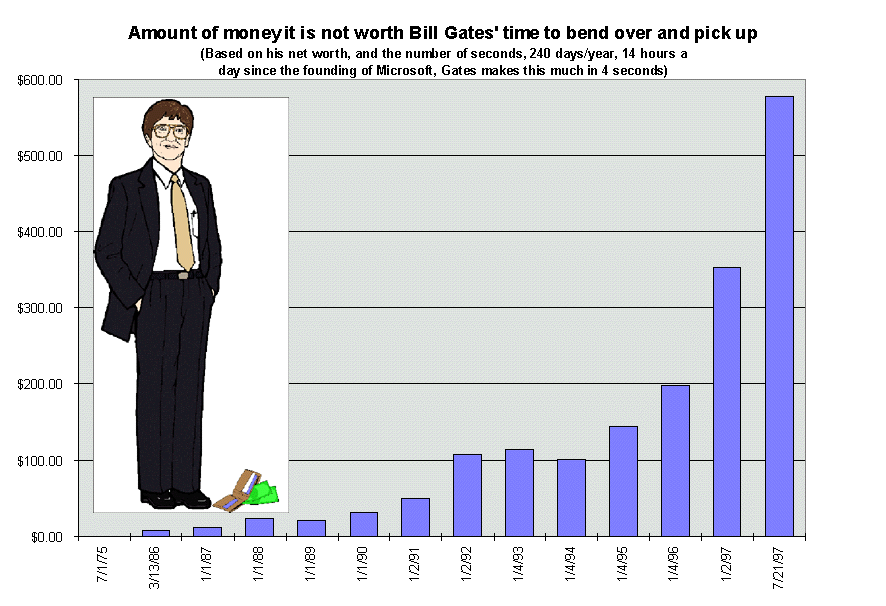
He nodded, thoughtfully chewing on his banana. "Ever hear of the 'Bill Gate's Dollar?"

"The what?"

Hogarth moved over to the white board and started drawing a graph. "It was a big concept back in the 90's. Folks were so obsessed with how rich Bill Gates was, they started figuring out things like how much money would have to be lying on the ground for it to be worth it to him to stoop over and pick it up." Hogarth continued mapping out the graph. "Back in '97 there had to be more than $600 dollars lying on the ground for it to be worth Bill's time to pick it up. He'd actually lose money if he counted a stack of $100 bills."

"Ouch!" I snatched my hand back from the innards of the server. Sticking my bloodied finger in my mouth I mumbled. "What's the point?"

Hogarth gave me another of those "are you really that dense" looks. You're paid <beeep> to be the program manager for this group. Should you be spending two hours fixing a server when someone else can do it in ten minutes? What are you not doing?"


Ouch…

Okay, so maybe I still do have some of my old tech support skills. Maybe I can still fondly remember when I could field strip a computer in about five minutes. And maybe my ego doesn't want to admit I've forgotten more about tech support then I thought. But most importantly the question is, "Am I being effective?"

It took me a hard time to get this one right. As a project manager, part of our job is to do the work no one else wants to. We are the facilitator, the remover of roadblocks, the maker of status reports, heck we make coffee if it will make the team more effective. But effective is the key word here. Everything we do should make the team, and ourselves, more effective. If it doesn't then do something about it.

Early on in my project management career I had one over riding rule. "Make sure it gets done, then find out who should own it." This certainly made me popular. You knew that if something fell into the cracks, I'd be there to rescue it. But did it need rescuing? Was I the right person to rescue it? While I was saving the cat stuck in the tree, was the project burning to the ground?

Does it need rescuing?:  Manager Tools developed a Koan around this very concept. The essential nutshell to this is when you get assigned some new, big, responsibility you need to look at the small things your doing and decide what of these can 'fall to the floor' (alternatively, if you have directs, what duties can you delegate to someone below you).  It is entirely possible that this task doesn't need to be done.

Mike Auzenne gives a great example of this. He took over a large division at his company. One of his jobs was to make the division more efficient. Sitting on a table in his office was this huge report that he had full time employees working to compile. Only he didn't know of anyone that actually used the report. So he stopped generating the report and moved those employees to something more effective. No on ever complained about the report stopping.

Are you the right person to rescue it: If you're really lucky, you have direct reports. If so then use a simple rule. "If there is a task that both I and one of my directs can do, then I should have my direct do it." Your typical servant-leader project manager has a little tougher judgment call, but it still needs to be made. Go back to that effectiveness measure. If doing it yourself will make the team, or you, more effective then do it. If it won't, find someone else to do it. This can even mean you end up putting it on your team. You're not there to make all the hard stuff go away, you're there to remove the roadblocks that they can't do so effectively. Sure you coded back in the 90's, but are you the right guy to debug the installer? Is there someone better suited?

Is the project burning down?: "Hey look! I just finished an end to end architectural diagram of the project. Took me a week, but man does it look good." That's great, and while you were doing that, the engineers missed three major status updates, failed to give a code drop to QA and the product manager didn't even want the feature they just built.

I've personally run into this one thanks to the "Shiny" factory. Some activity that I really shouldn't have been doing, but it was compelling in some way. While obsessing on this minor thing, I let major things slip between the cracks.


I firmly believe the project manager is there to make the team more effective. That often requires the project manager to step in and do things that need to be done. But before you do, ask yourself three simple questions:

"Does it really need doing?"
"Can someone else doing this better?"
"Is there anything else more important right now?"

Joel Bancroft-Connors
The Gorilla Project Manager
Want me to talk to your gorilla? Send me an email
You can follow me on twitter, @JBC_PMP


Friday, May 27, 2011

It's 3:30, do you know where your gorilla is?

We were really cranking through the PowerPoint. I was so energized. We were finally making some honest to goodness progress on the project plan and I had some glimmer of hope that we'd make the next milestone.

All of a sudden Jake looks down at his phone. His face soured for a second and then he quickly shut his computer. "I've got to go to another meeting."

Another meeting? I started to panic, but we were making so much headway! We had a great agenda and we were plowing through it. And besides, I'd scheduled this meeting weeks in advance and everyone knew just how important it was. Why was he leaving early?

Then Bob glanced at his phone, tapped a couple of keys and stood up. "Yeah, I'm late for a client meeting. Gotta run."

Sigh… I was used to Bob texting in the meeting, but again this was scheduled! He knew it was scheduled.

Sue and Carlos started packing up their gear as well. No…

What was happening?

Hogarth leaned forward. His large size meant he could easily sit in a chair on the wall and still whisper into my ear. "Maybe you should check the time?" he offered.

The time? Wait, what? I looked down in the right corner of my computer screen… dang, in PowerPoint slide mode you can't see your task bar, no clock. I looked up on the wall. Oh, right. The clock in this room was missing. Finally I dug into my back pocket to dredge out my iPhone.

3:05! Five minutes over? How did we get to be five minutes over? I had an agenda!!

Hogarth was there to offer his "helpful" advice. "Maybe a watch would help?"

I looked down at my bare wrist… "A watch? How 20th century, I've got an iPhone and a computer."

He began to casually peal a banana, "How's that working out for you?"


A Wrist Watch? A Wall Clock? Really?

It's the digital age. I've got a clock in my car, a clock on my computer, a clock in my iPhone, a clock on the desk phone. There are clocks in almost every piece of technology out there. So why then do we need wrist watches and wall clocks anymore?

Why indeed…

Perception and Effectiveness

I have talked about Effectiveness many times, you can read an entire blog on it here. And Perception is really just another aspect of effectiveness. If perception is off, then you can't be fully effective.  So it can be said that perception is effectiveness.

So why isn't my iPhone effective? It does everything I need!

Efficiency is not always effective. The iPhone (or any other smart phone) is a wonderful tool and it is not unlike my own mantra of a $200 tool box over a $1000 dollar screwdriver. And while the iPhone can do everything, it is sometimes like trying to use a Swiss Army knife the size of a loaf of bread to screw together a set of eyeglasses, big and cumbersome. Or in the iPhone's case, it is the perception that is an issue. The toolbox is better than the platinum screwdriver, but you have to take tools out of the toolbox to be effective.

Look from the outside. You see someone pulls their phone from their pocket. They do something with it, and then they put it back. What did they just do? There in lies the problem. When you can do any of a thousand things, people may well assume he's doing something other than checking the time. "Did he just get a text message from Bob? I knew Bob didn't like me." Much like in the "I can see you Gorilla", people typically will assume you are doing something not productive when you are fiddling with your phone. This  isn't just about being in meetings. A wrist watch may be a single tasker device and thus not "efficient", but it is a highly effective device. When you look at it, people know exactly what you are doing. It is incredibly easy to use as well. Sure, your cell phone is on the table and you just have to push a button. Your watch is on your wrist, just roll your arm two inches and look down, simple.

An analog wall clocks serves an equal value, especially in meetings. If you run an effective meeting, you have a time boxed agenda. Each item starts at a specific time. That wall clock makes it easy for everyone to know what time it is. Post the agenda right next to it and people can see exactly where the meeting is.

Everyone has a computer, they all know what time it is!

 In an ideal world, only the presenter would have a laptop. Of course we don't live in an ideal world and most folks will have their own laptop, so why not just have everyone use the clock on the screen? Is their computer's time correct? Can they see the clock with the stuff on their screen? Do they look at the clock? Manager Tools also pointed out that a digital clock can lead to a disassociation with time passage. You look at the clock and it say 1:30. That's a single snapshot in time. You look at a wall clock and you can see a visual representation of how much time is left, is passing, has passed.


My advice
Wear a watch: It's a highly effective tool. People know exactly what you are doing when you look at it. An added bonus is the watch can help to improve your overall appearance and looking professional is effective.

Own a wall clock: I have my own clock. I take it with me to any meeting where I'm not 100% sure the wall clock works and is easily visible (If the clock is on one wall and the projection screen on the opposite wall, people have to turn around to see the time). Fashion up a little stand for it and place it at the end of the table.

Keep you phone in your pocket: Put it on stun and leave it in your pocket. Remove the temptation to check it .

No computers in the meeting: I already referred to the "I can see you Gorilla", but it bears repeating. Recently it was reported that the head of Google declared no more laptops in his meetings. If the uber technology head of Google sees the value of leaving the laptop home, maybe there is something to this thing…

Stay on time, stay effective:

Joel Bancroft-Connors
The Gorilla Project Manager
Want me to talk to your gorilla? Send me an email
You can follow me on twitter, @JBC_PMP


Friday, May 13, 2011

The gorilla in the forest, through the trees

"Man! Did you see that pass, it was sweet!"

"Apparently the team's chopper had a malfunction, the explosion was the scuttling charges."

I wound my way through the incomprehensible hallway conversations, making for my desk and the incredibly long to do list waiting for me.

"Hey!" Bob called out to me. "Some speech, wasn't it?"

I gave a half nod and walked faster.  "Speech?" What the heck was he talking about?

I settled into my desk chair, just in time for Molly to wander into my cube. "So you thinking about applying for that Agile certification?" Molly was a project manager over in the IT organization and she loved to talk project management shop. I just wish I knew what she was talking about half the time.

"Uh, not sure. What do you think?" I asked.

She gave a shrug. "Dunno, Tobias Mayer certainly has panned it. Not surprising though, he's not big on traditional PM. Rory Corkle wrote a good blog on why he's behind it, but I think he's going to make money training so not sure if he's unbiased."

"Tobias, Corkle? What the heck is she talking about?" I asked myself. Thoroughly lost I shrugged and gave what I hoped was an interested answer. "Tough call."

She cocked her head to the side, giving me that same look she always seemed to give me. She said something pleasant and wandered off. Supposedly Molly is a big information junkie, but I don't think I've ever had a conversation that lasted more than a couple minutes. Guess she doesn't know as much as folks think.

I turned back to my computer, way to much to do on this proje...

THWAPPPP!

"Ow!" I yelped. Grabbing the back of my head, I spun around. "Hogarth! What the heck was that fore?"

Hogarth grunted and glared at me. "For someone so smart, you sure are thick."

"What?"

"Do you have any clue what's going on around you?"

I sat up straight, offended at his question. "Of course I do. Quality just finished sanity on build 42. Bob's working on a change order for support of the new MacroFirm browser. And the prewire for the design review went off without a hitch. This project is going great!"

Hogarth waved a freshly peeled banana at me. "There is more to the world than the project, you know that?"

"No, there's not. If I don't get this project out on time, I lose my bonus. Heck, the way things are going I might get a pink slip. If its not the project, then I don't care.."

Spwap, spwap…. The sound of a banana peel smacking across my cheeks was strange to my ears. Fortunately the peel didn't hurt that much.

"You need to care," said Hogarth. "For example, Jake is a rabid Sharks fan. Did you know they were in the playoffs and if the Sharks win he'll probably take a couple days off?" He pointed the direction Molly had gone, "Molly just got a cold recruitment call from someone she met at the last PM Chapter meeting. Seems he was impressed with her grasp of how the recent changes in Agile are impacting the business bottom line. Oh and the most notorious terrorist in the world was killed, Bob was talking about the President's speech on that."

"Why would the CEO being talking about a dead terrorist?"

THWAPPP!

"You are hopeless!" Hogarth growled. "It doesn't matter if you are the best damn Gantt chart master in the world, if you don't know what's going on in the world you won't stay relevant and won't be able to communicate with your co-workers!"

Right then one of my co-workers poked my head into my cube. "Hey, some of us are headed to In and Out Burger* for lunch. Want to come?"

"Is that a new burger place?" I asked.

THWAPPP!

*- In and Out burger is a popular fast food restaurant in the southwestern portion of the United States. It has been around for several decades.


We work forty or more hours a week. During the work day if we don't look insanely busy, people wonder why we're not working hard enough. When we get home, most of us are dog tired and just want to collapse on the couch.

And now we're supposed to take time to pay attention to world? Okay, so I'll catch the evening news headlines. I can do that from the couch. What more do I need to do?

I have a friend and fellow project manager. He had worked for eighteen straight years, most of that at one company. He'd not had to look for a job in all that time. When he did change jobs, the new job found him. In that time he never thought about looking for work, never factored that into something he needed to stay current.

So when he found himself out of work, in 2009, he suddenly discovered he was completely out of touch with how job hunting worked now. The last time he'd updated his resume, it was expected that you put your mailing address on it. When was the last time you put your mailing address on your resume?

I don't follow sports that much. Never been much of an interest to me. Sure, if the local team makes it to the playoffs, I'll turn into a loyal fan (Go Giants). But once the World Series is over I'm back to my normal indifference. At one of my prior companies, the guy down the hall from me was a rabid Giants fan (US Baseball). If I wanted to relate to him, I had to at least understand the basic language of baseball. If I didn't I wouldn't have understood half his explanations. "Oh that project is a base hit." (Translation- "That's easy to do, won't take much effort").

Ever come into the office, only to discover the company you work for is now owned by some holding company in India? Stealth acquisitions are not unheard of, but most of the time you can see change in the wind, if you just pay attention to your company in the news.

Did you hear about the new PMI test standards? Yeah, you have to stand on your head when you take the test. (Okay, not really. But if you don't keep up on the PM community how would you know?)


It comes back to effectiveness. When communication is about what the listener does, you need to communicate in their language. To do that, you have to make an effort. If you come to work everyday, go to your cube, do you job and then go home, nothing more, well you're not going to be effective. It doesn't matter if you're the best project manager in the world, master of the Gantt chart, queen of risk analysis. If you can't communicate effectively then you fail.

I learned this lesson the hard way. The best thing that ever happened to me, was getting laid off when I least expected to be. It challenged my assumptions. It woke me up and it caused me to take a second look at things. If something as obvious as that layoff could catch me by surprise, then what else was I missing? It was this moment, when I realized the huge forest of my career was made up of thousands of individual trees. Being laid off set me on the path I am on now. As I looked back on my career I started to realize just how many mistakes I'd made.

And not staying current has been one of the biggest. I used to not grasp that at least knowing if the local sports teams were winning more than they were losing would be useful to my career. Who cares if there are layoffs on Wall Street? That doesn't impact me in Silicon Valley, right?

So what do I do?:
I don't work any less hours, but I do make my non-work my time more effective.

Stay up on Current Events: Manager Tools hands down recommends reading the Wall Street Journal. Excellent advice but not something I could take myself. With a two hour commute I can't read. Fortunately we now live in an age of information overload. You can stay current very easily.

Podcasts are you friends: There is a podcast for darn near anything you need. Below I give an example of what I follow. The important point here is you would be surprised how much "down time" you have when you can listen to something.

 Walking the dog, Using the Stairmaster, driving to work, walking at lunch, etc. You may not have the time to sit down with the WSJ (or other print publication), but few of us don't have time in the day when we can listen.

I've recently started using the Stitcher Radio iPhone app (also available for the Android). This has made podcasts even easier. I don't have to worry if I synced my phone, I just stream the podcasts I follow. For most of my daily or short podcasts I use Stitcher. For weekly or longer podcasts I still use iTunes.

My Podcasts:
Some of these keep me up on current news. Some of these keep me up on interesting trends.  Some (like Dinner Party Download), give me conversation starters.

APM Marketplace (daily)
APM Marketplace Morning Report(daily)
NPR Hourly News Summary (daily)
APM Marketplace Tech Report (daily)
Wall Street Journal What's News (daily)
APM: The Dinner Party Download (weekly)
Freakonomics Radio (weekly)
BBC Click Radio (weekly)
Quick and Dirty Tips Podcasts: Grammar Girl, Get it Done Guy, Legal Lad, Money Girl and The Public Speaker (weekly)
Manager Tools (weekly)
Career Tools (weekly)
NPR Wait, Wait, Don't tell me (weekly)
60 Minutes (weekly)
The Project Management Podcast (Bi-Monthly)
The Cranky Middle Manager (weekly)

Stay up current on your industry: Things change, even in the most stagnant industry things will change. People change, as well, a lot more often. You need to know what is going on, who is saying what and why. You don't have to be an expert, but you should at least have an idea.

RSS Feeds- I use Google Reader to follow several PM and Management blogs. I try and read it twice a week. If I fall behind, I don't kick myself and I don't let it keep me from reading. If I'm really behind, I mark it all read and try better next week.

Forums/Discussion Groups- There are a wealth of forums on every industry. LinkedIn alone is a great resource. Read and participate! Same rules as the RSS feeds. Don't feel you have to read it all. On a bad week, I'll not even touch them, but I always come back to them. In addition to the many project management related LinkedIn groups, I highly recommend the project management board on stack exchange.

Stay current with your network and peers: If you never leave your cube, you'll never meet your next boss. Staying current with your peers and professional network is vital. If I get a request for help from two people, one I haven't spoken to in ten years and one I just saw at a breakfast meeting last week, who am I more likely to help? You don't have to even leave your cube! My two tips:

Networking Events: Here in Silicon Valley, the PMI chapter hosts several morning and evening events each month. Beyond that there are dozens of relevant groups on Meetup.com. Even if your PMI chapter doesn't do this, or you don't have Meetup events around you, there are people meeting and talking. Find them and meet with them. I attend PMI events as well as local Agile related events. Oh and I'm part of my local PTA. Yes, the PTA. A good chunk of my fellow parents are also professionals in the valley and we have a lot to talk about.

Send an emai!: The easiest way to stay current. Go through your address book (or LinkedIn contacts) and set yourself a reminder. One person a day, send an email. Just drop a line, ask how they are doing, share something you learned, etc. At a loss for words? Check their LinkedIn profile. Nine times out of ten, they'll be something there to talk about.


So the next time you walk down the hall and hear "What a pass," know if they are talking about the latest hockey game or the latest football game. When someone asks about the latest PMI certification respond with, "yeah I read a great blog about that, made me type up one in response."

Stay current, stay effective.

Joel Bancroft-Connors
The Gorilla Project Manager
Want me to talk to your gorilla? Send me an email
You can follow me on twitter, @JBC_PMP


Wednesday, April 27, 2011

Armchair gorilla

Note: For new Gorilla Blogs, head over to The Gorilla Coach

- Or walk a mile in the gorilla's shoes

This blog inspired by Tobias Meyer's recent blog "Scrum is not Project Management"

Normally I don't let Hogarth follow me home. There are limits and that's just one of them. The thought of an 800 pound gorilla on my couch is a terrifying one. And then there is what he does to the refrigerator. Did I mention gorilla hair on the white carpet? But it was the Superbowl and I had a moment of weakness.

"Come on! You call that a pass? My mother can throw better than that." I angrily waved at the TV while speaking through a mouthful of Dorritos. "Can you believe this guy, Hogarth? That play had blitz written all over it. I swear even a deaf bat could have seen it."

Hogarth looked at the dried banana chip poised to be popped into his mouth, then looked at me, then looked back to the chip. Sighing he lowered the chip and gave me a reproachful look.

"How much football have you played?" He asked.

I looked aghast, "Me? Last time I played footbal, it was with flags and I was still too young to vote."

Hogarth gave a sage nod. "I see. I bet you didn't even stay in a Holiday In Express last night."

It was my turn to sigh. "Okay, okay, I get the point. Not only am I not there, but I'm not a quarterback, have never been a quarterback and don't have the first clue how to be a real quarterback." I shook my head, "I'm sitting here trying to second guess the expert. Talk about stupid."

Hogarth nodded again. And then he spoke, his words breaking the 4th wall and my own train of thought. "So why are you trying so hard to prove Tobias wrong?"

I turned to stare at Hogarth my mouth agape. No sound came forth despite the repeated opening and closing of my bass like mouth.


Why indeed?

I make my living doing a job that typically has the job title of "Project Manager" or "Program Manager." Given that, it may be understandable to you that my emotional reaction to Tobias' blog was to disagree.  I certainly did this initially. The first few comments I thought about leaving to his blog were much less reasoned than what I ended up posting.

And then, much like my revelation in "A Project Manager's Poker Hand," I came to a realization that I was trying to impose my own value on someone else. Worse yet, my value was based purely on emotional reaction, where as the opinion espoused by Tobias was based on subject matter expertise.

Yes, I have Scrum training, I've studied Scrum and I've even incorporated some Scrum concepts into product development efforts I've been involved in. But I am most certainly not a Scrum expert. I've never worked on a classic Scrum team and I can't speak from first hand experience.

Tobias on the other hand has. He is a recognized expert on Scrum teams and Scrum development. Without my own "traditional" Scrum experiences, I have to put faith and trust on Tobias speaking from that expertise.  I don't know enough about a straight Scrum project to know if a "traditional" project manager would bring any value. I certainly hope to learn and understand more as I delve into the Agile philosophy, but for now I have to take Tobias at his word. Just as the Product Owner must trust the teams estimates, I should trust Tobias' expertise.

So as the saying goes, "Don't judge another, until you've walked a mile in their shoes."


All right, so Scrum is not Project Management.

What is project management then?

It was something of a wake up call to read some of the very acerbic comments posted both in Tobias' blog and Ken Schwaber's blog that inspired Tobias' blog (Yes I'm a response to a response). That people think project management is an evil tool of "corporate" or an "idea whose time has passed," was not something to cross my mind. Even Ken's own words had me blinking in confusion.
"We have found that the role of the project manager is counterproductive in complex, creative work. The project manager’s thinking, as represented by the project plan, constrains the creativity and intelligence of everyone else on the project to that of the plan, rather than engaging everyone’s intelligence to best solve the problems."

"Wow, that's not the project management I know" was my initial thought. I certainly have never felt I was stifling creativity or constraining anyone's intelligence. I was an art major in college and write science fiction as a hobby, not exactly what I would think of as an oppressive personality. Yet, the comments posted certainly had me wondering. I had to check myself in the mirror and make sure I wasn't wearing a black mask and breathing funny. <Darth Vader voice> You underestimate the power of project management.</voice>

So before I accepted my role in the dark side of corporate america, I decided to look for other definitions.

PMI's PMBoK defines project management as:
"Project management is the application of knowledge, skills, tools, and techniques to project activities to meet the project requirements."
And they define a project as:
"A project is a temporary endeavor undertaken to create a unique product, service or result. "

Okay, so not the most evocative words ever written. And I can already see issues with the definition of a project and the normal evolution of software. When version 1.0 ships, the team has usually already begun on version 1.1. Is the project the software as a whole or just v1.0. What is "done"?

Wikipedia, font of all knowledge, real, imagined and inaccurate, defines project management as:
"Project management is the discipline of planning, organizing, securing and managing resources to bring about the successful completion of specific project goals and objectives."
And Wiki defines a project as:
"A project in business and science is a collaborative enterprise, frequently involving research or design, that is carefully planned to achieve a particular aim."

Okay, so neither source's definition is going to make a kid say "Daddy, I want to be a project manager when I grow up." And honestly, neither source really describes what it is I do in my day to day job.

Certainly I spend time organizing and planning. I've both helped develop goals and objectives for a project and served as a gatekeeper to ask if we'd met them. Goodness knows I have built a lot of knowledge, practiced a lot of skills and developed a big old toolbox of techniques. But I don't think that defines what I do in my job or why my boss keeps paying me to do that job.

I know some folks think of project management as the "Owner" of a project. I've known project managers who "owned" the project. They were the almighty power and controlled the budget, the people, the project and final deliverables. This does still happen, but at least in the high tech firms I've worked for, this is less and less common. The guy in charge of building a bridge is a project manager and also the head engineer, this guy is the "owner." A guy managing a software team doing an IT integration project is not the "owner". The team all report to functional managers and the guy managing is more like the cat herder (We won't go into the myth today).

So what is being a PM mean to me?

Well not to sound like a broken record, but I would stat by reaching back to my "The gorilla with too many hats" and "Project Managers are SMES" blogs to start answering this question.
"If you have four engineers working on the project..., adding a fifth one is already starting to hit that wall of diminishing return. If you add a program manager, you can get more productivity from those four engineers, than you would from adding a fifth engineer and expecting one or more of those engineers to also manage the customer relationships, deadlines, certifications, interface with marketing, etc."

"A Project Manager's SME knowledge is in getting a project from inception to launch with in the bounds of the project's constraints and while keeping the team from flying apart like wine glass shattering when it hits the floor."

I've been doing dedicated project/program management for a decade now. In that time I've never had any illusions of being "in charge" of a project. Long before I heard the first utterance of "Agile" or "Scrum" I was practicing servant-leadership.

I am the broom:  Pam Stanton as well as a good friend and fellow project manager, Carl Jones have both used an example that I think speaks to what a 21st century project manager is. They compare our job to that of the game of curling. The curler and the stone are the product/project team and the product being built. The Curler's (team's) goal is to get the stone (product) to the center of target area (release date, objectives, value needed, etc.). The Curler is the main person. Without him you don't have a game. But he is not alone.  The sweepers use brooms to alter the state of the ice in front of the stone.

A good project manager is like a curling sweeper. He gets in front of the product and makes sure there are no impediments (Test equipment was ordered, team has a place to work, external vendor is managed to deliver its dependencies, etc.), but also makes sure those things that have to be done (certifications, compliance, sponsor updates, etc.) get done.

Over the years I've developed my own personal philosophy/methodology to being what I am as a professional:
  1. People, not projects
  2. It's all about communication
  3. Process is a tool, not a roadblock
  4. There is no one, right way

I don't know if I'm a traditional project manager or program manager. I know I'm not a traditional scrum master and there isn't even a standard definition of an agile project manager. But at the end of the day I don't think any of that matters. Because what I know I am is:

Effective

Joel Bancroft-Connors
The Gorilla Project Manager
Want me to talk to your gorilla? Send me an email
You can follow me on twitter, @JBC_PMP