Tuesday, July 19, 2011

No one expects the Gorilla Retrospective

Jake was pinned to his seat by the spotlight's intense beam. "Where were you when the code check-in introduced four P1 bugs?"

"I, uh, what?" Jake stammered.

I spun the spotlight and speared Bob with its white light. "The requirements document failed to take into account the Fergusson account. Why?"

Bob shifted in his seat. "It was Jane's fault, she didn't file a sales report for Fergusson!"

Jane's mouth dropped open and she reached for her cellphone. Somehow I didn't think she planned to text Bob with it. Not from the way she was holding it over her head.

Now I was getting somewhere. This post-mortem was finally getting to the bottom of things.

But before I could turn the spotlight towards Jane, a figure leaped onto the table and blocked my view. Jumping back, I looked up at the strange visage before me. Yards of red satin swirled about, all but obscuring the figure beneath it. A red galero covered the figure's head, its deep crimson so dark it nearly blended with the black hair that lay beneath it. The darkness of satin and hair offset the brilliant white teeth of my interloper, making him suddenly recognizable.

Hogarth struck a preposterous pose and declared, "No one expects the Gorilla Retrospective!"


The Post-Mortem:
If you have ever sat through a grueling multi-hour project post-mortem, you probably wished for the inquisition to sweep in and put you out of your misery. The very term means "after death." What a delightfully pleasant term for this meeting. Let us examine the corpse of the project and see what killed it. Let's not trouble ourselves with the fact that the project actually shipped and is a success. No, that would be pointless.

The purpose of the meeting is to tear apart the project and find everything that went wrong. As the project manager, you will assemble a mammoth document that goes into sickening detail. Even if you tell people "we aren't here to blame anyone", blame will be assigned and buses will be thrown on top of people (or something like that).

And when it's all over, the report is dutifully filed in some file cabinet (real or virtual) and promptly forgotten. No one goes back and reviews it. No one wants to remember the painful experience of exhuming a successful project for failures.

A rose by any other name:
Okay so we won't call it a post mortem. How about lessons learned or a retrospective? Yeah, that's the ticket. Now who's fault was it that we shipped with no user documentation?

You can slap lipstick on the pig and it will still be a pig. Changing the name of something, but not how you go about doing it, is just going to make folks dislike the new name as much as the old.

So many companies look back on their projects to find what went wrong and fail to try and do better the next time.

Break off that rear view mirror:
I've met no small amount of people who think the George Santanya quote "Those who cannot remember the past are condemned to repeat it" means we have to live in that history. Relive every mistake and wrong to determine exactly why it happened.

Not so. The horses are already out of the barn. Grilling the ranch hand on why he left the door open isn't going to do much. It doesn't get the horses back and it doesn't really do anything about the future. Manager Tools recently did a podcast called "There is no why in feedback." The Feedback Model is a manager tool for communicating about both the good and not so good things your directs do. The big key to it is that it doesn't focus at all on the past behavior. It just focus on the future.

 An example:
"Don, can I give you some feedback? <wait for answer> "When you are late to the meeting, we start late and can't finish the agenda. This means not everyone gets a chance to be heard. Do you think you could change that next time?"

Read the last sentence again. "Next time." The manager doesn't dwell on the previous issue, instead he dwells on it not happening again.

And that's the secret to a great retrospective. Focus on the future. Don't assign blame. Don't dissect every problem. Don't get lost in the spilt milk. Focus on doing better the next time.

Forward looking:
When I do a retrospective I pull out another tool from my Manager Tools bag. On the left side of the white board I write "What Went Well." On the right side I write "Things to Look At."

The latter is important and I always stress it. TLA isn't about blame, it isn't about why, it isn't even about negative. It is simply things we want to look at for the future. This can mean you end up with things people would generally refer to a "positive" on the Things to Look At side. After a good retrospective, I often have lines drawn from items on the WWW side to the TLA side. Things that were not part of the normal process, that had a good impact and the team wants to do it again.

The next step is to lay down the brain storming rules. When using the brain storming rules there is no "No", "But", or "I don't agree." Brain storming is a safe zone where anyone can throw out anything and there will be no discussion, no argument and anything goes. If someone yells out "Pepperoni Pizza," my only response is "Is that a 'Went Well' or a 'Things to Look At'?"

When you're done collecting your WWW-TLA you then give everyone something to vote with. Small teams can use markers, larger teams work well with stickers or even post its. Let everyone vote two or three times on the TLA side. Then you tally up the votes and you've got your top things to look at changing for the next time. Short, sweet, to the point and very effective.


Don't make your retrospectives a full court trial. Don't dwell on the past. Do make it safe for people to reflect. Do focus on the future.

Joel Bancroft-Connors
The Gorilla Project Manager
Want me to talk to your gorilla? Send me an email
You can follow me on twitter, @JBC_PMP

Friday, July 8, 2011

Gorilla Spam- Not appetizing, Not good practice


Or- How not to be a Twitter Sinner


My computer finished resuming with a happy chirp. In seconds it was pulling down data from the internet and my applications were all madly updating. Taking a slug of coffee I popped open Tweetdeck and looked to see what gems the night's rest had produced. Two minutes later I'd already pushed out at least a dozen retweets

"Whoa there, Tex, slow down with that keyboard. Do you know how fast you're tweeting there?"

I didn't bother to look at Hogarth. He was no doubt looming behind me with a disapproving scowl on his face, that's what a gorilla in the room does. I shrugged, "about a dozen in the last two minutes."

My gorilla stepped close enough for me to see his reflection in my monitor. He was counting on his fingers. "About a dozen? So you're saying that you are pushing out a tweet every 10 seconds? You do know that it takes on average five to eight seconds just to read a tweet? You actually want people to pay attention?"

"Hogarth," I said. "I've got just a few minutes to retweet here, before I have to get to work. I have to go fast."

Hogarth grunted. "You remember Tommy, the engineer?"

I shuddered, "Oh god, he used to write emails in the middle of the night. By the time I got in the office, I'd have twenty emails from him."

Hogarth nodded. "And how many of them did you read?"

Ouch…  Okay, Hogarth had a point. I threw up my hands, "Okay, fine! So I I'll cut back to one tweet a minute."

I turned back to my computer. Giving a sigh I watched my clock tick down a full sixty seconds. As the second hand swept past the 12 I clicked on a tweet and selected the retweet option. With a satisfied grunt I hit enter. "There!"

"Don't you even read them?"

Shaking my head, I said "These are pure gold, I only follow the best, I don't need to actually read them." I pointed at my screen, "Look at this one. It's from @PMUberGuru. This guy pulls down high five figures for a one hour speaking engagement. I don't need to read his stuff, it's guaranteed to be good stuff!"

Hogarth gave a grunt of surprise. "Well that's interesting."

"What?"

"This email I just got," Hogarth said. 

I spun about in my chair, "what email?" I began only to stop before I finished the thought.

Hogarth had a banana shaped device in his hands. It was lying flat in his palm and split open down the middle. He pointed at the device."iBanana,"

Giving me enough time to roll my eyes he continued. "It's an email from @PMUberGuru. Seems his Twitter account was hacked and the hacker sent out tweets pointing to some really nasty malware web sites. You know the kind, soon as you hit the page its trying to convince you your computer crashed or something, just click this button to reboot your computer."

The sheer insanity of Hogarth using a banana shaped phone was quickly shoved to the side as the full impact of his words sunk in.

"Oh…. Crap…" 


Are you a Twitter spammer sinner?

TSSS- Twitter Spammer Sinner Syndrome. So like any good, social media using, project manager I follow the #PMOT hash tag. It has been a source of some truly great project management insights. Unfortunately, I often wonder if it is worth the effort. Much like a needle in a haystack, you have to really hunt for those gems. And when I have to hunt for useful information in a Twitter feed, then it's not really worth it.

One evening I was working late. I could tell that this one project manager had just fired up his computer (maybe in meetings all day, maybe he's in AsiaPac). In the course of five minutes he'd retweeted close to thirty tweets.  With the settings on my Tweetdeck that meant that just about when one tweet was fading from my screen, it was replaced by another (I've since change Tweetdeck to only show new tweets every ten seconds and am considering disabling notifications all together). At that point I'd had enough and I closed my Tweetdeck. When I fired it up the next morning and scrolled back through #PMOT there was an hour's time period where this PM was the only tweets on the hash tag and there were a lot of them.

You know what happened? I don't even give his tweets a second glance and I certainly have no plans to ever follow him directly.  When I see his picture, I just look to the next tweet. He may be a truly brilliant project manager, but he spammed me and that's just not okay.

Spamming is the first sin of Twitter.

I think there are at least two other cardinal sins and I'm not alone:

Sin #2: Multi Blasting
Irene Koehler first put words to this sin for me. In her blog, "Connecting Twitter to LinkedIn: Just Say No," she gives an impassioned argument on why you shouldn't have your tweets automatically post to LinkedIn.  I can't agree with her enough on this and it also goes for doing the same with linking tweets to Facebook. It is not uncommon that if you are following someone in one Social Media, you follow them other places. They are all different communication methods and the last thing I really want to do is see the exact same post in LinkedIn, Twitter and Facebook.

More importantly, LinkedIn is about professional status and networking. I do not need to know where you just had dinner. I've removed people from my LinkedIn network for this.

Related to this is Foursquare. I'm not on Foursquare. I don't want to be on Foursquare and I absolutely don't care if you just became mayor of Costco. If I want to follow your Foursquare progress, I can add a Foursquare thread to my Tweetdeck. I've unfollowed people who tweet their Foursquare.

Sin #3: Twitter is not a bulletin board
I hadn't even realized this was bothering me until I read Tim Tyrell-Smith's (Tim's Strategy web site for career tips and advice) recent blog; "Don't Follow Me on Twitter - Talk To Me"

Tim points out this sin wonderfully well, but I'd like to offer up an analogy of what is going on here.

I walk into a coffee shop. Ignoring all the patrons in the shop I wander over to the bulletin board and tack up my lost dog poster. Then I walk out of the coffee shop and go repeat the process at a half dozen other shops. Meanwhile, back in the coffee shop, a lady finishes paying for her coffees and heads out to her car where her husband waits. I helpfully hold open the door for her, before heading off to my next place to post flyers.  When she gets into the car, she asks her husband "so should we make flyers for this found dog?" The dog in the back seat just wags his tail.

Twitter is becoming the bulletin board of the internet. People don't post to have conversations, they post to convey information. They use it as a sign post to their blogs (I am completely guilty of this). Instead of being a destination, Twitter are the signs on the side of the freeway. Gas, Food, Lodging, Blog posts...

I maintain two Twitter accounts, one is for my professional project management and the other is a cross between personal and for my freelance fiction writing. As I examined my two accounts I found my professional account was filled with sign posts. Whether it was myself or the people I follow, the tweet feed was filled almost completely with posts to other places. There are no conversations. In contrast, my private feed is filled with dialogue, interaction and "community."

Twitter has the potential to be a powerful communication medium. Unfortunately we are in danger of it turning into a mind numbing information pipe. Ever heard the expression, drinking from the fire hose?

Make Twitter cocktails with friends not drinking from the fire hose.

Make Twitter, "cocktails with friends", not, "drinking from the fire hose".

Leave the Spam to the professionals:

Joel Bancroft-Connors
The Gorilla Project Manager
Want me to talk to your gorilla? Send me an email
You can follow me on twitter, @JBC_PMP

Friday, July 1, 2011

The Gorilla Dollar

Or- Are you making the most of your time

I was elbow deep in the case of a server. I'd almost gotten the broken fan free, if only it would just…

"Wha'cha doing?" Hogarth asked. Let me tell you, when an 800 pound gorilla starts sounding like a Fireside Girl, it certainly gets your attention.

Looking up from the computer I said "Oh, great, your just in time. Pass me that screwdriver, will you?" I pointed at the tool box on the table.

"Why?" my gorilla asked.

"Because I need it to get this fan out."

"Why?"

"Because the fan is busted!" I was starting to get annoyed with the three-year old style question and answer.

Hogarth wandered by me and took a seat in my desk chair. "Why are you fixing a broken fan?"

Stomping over to the table, I snatched up the screwdriver. Speaking very slowly I said "because the fan is broken. If the fan is broken, the computer overheats. If it overheats, it shuts down. If it shuts down, then the server doesn't work."

Hogarth pulled out a banana. "Uh huh. How long you been at it?"

I glanced at my watch. "About ninety minutes. These new server chassis are a bugger to open."

Waving his half-pealed banana in my direction Hogarth said, "Wouldn't it take the IT guys about ten minutes to do that?"

I shrugged, "Yeah, but I can do it. I don't want to bother them."

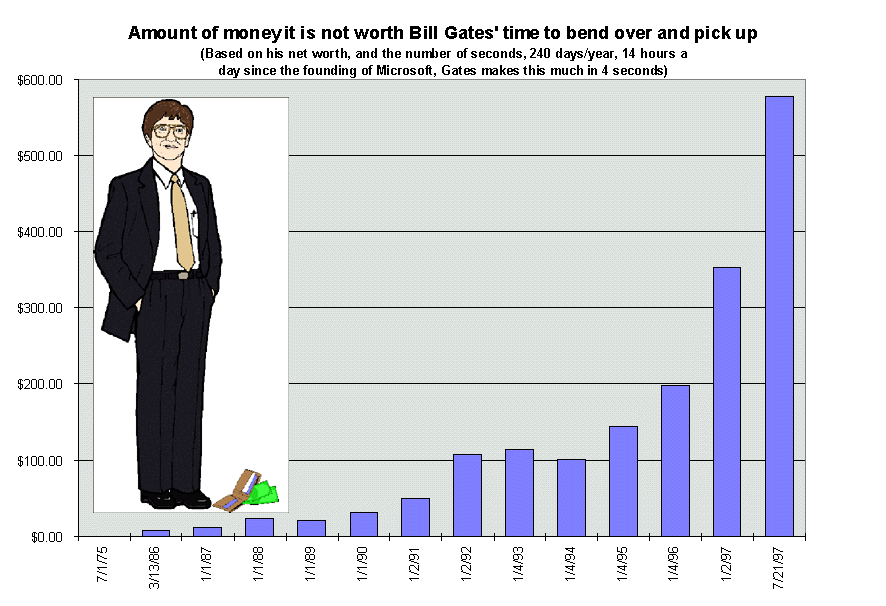
He nodded, thoughtfully chewing on his banana. "Ever hear of the 'Bill Gate's Dollar?"

"The what?"

Hogarth moved over to the white board and started drawing a graph. "It was a big concept back in the 90's. Folks were so obsessed with how rich Bill Gates was, they started figuring out things like how much money would have to be lying on the ground for it to be worth it to him to stoop over and pick it up." Hogarth continued mapping out the graph. "Back in '97 there had to be more than $600 dollars lying on the ground for it to be worth Bill's time to pick it up. He'd actually lose money if he counted a stack of $100 bills."

"Ouch!" I snatched my hand back from the innards of the server. Sticking my bloodied finger in my mouth I mumbled. "What's the point?"

Hogarth gave me another of those "are you really that dense" looks. You're paid <beeep> to be the program manager for this group. Should you be spending two hours fixing a server when someone else can do it in ten minutes? What are you not doing?"


Ouch…

Okay, so maybe I still do have some of my old tech support skills. Maybe I can still fondly remember when I could field strip a computer in about five minutes. And maybe my ego doesn't want to admit I've forgotten more about tech support then I thought. But most importantly the question is, "Am I being effective?"

It took me a hard time to get this one right. As a project manager, part of our job is to do the work no one else wants to. We are the facilitator, the remover of roadblocks, the maker of status reports, heck we make coffee if it will make the team more effective. But effective is the key word here. Everything we do should make the team, and ourselves, more effective. If it doesn't then do something about it.

Early on in my project management career I had one over riding rule. "Make sure it gets done, then find out who should own it." This certainly made me popular. You knew that if something fell into the cracks, I'd be there to rescue it. But did it need rescuing? Was I the right person to rescue it? While I was saving the cat stuck in the tree, was the project burning to the ground?

Does it need rescuing?:  Manager Tools developed a Koan around this very concept. The essential nutshell to this is when you get assigned some new, big, responsibility you need to look at the small things your doing and decide what of these can 'fall to the floor' (alternatively, if you have directs, what duties can you delegate to someone below you).  It is entirely possible that this task doesn't need to be done.

Mike Auzenne gives a great example of this. He took over a large division at his company. One of his jobs was to make the division more efficient. Sitting on a table in his office was this huge report that he had full time employees working to compile. Only he didn't know of anyone that actually used the report. So he stopped generating the report and moved those employees to something more effective. No on ever complained about the report stopping.

Are you the right person to rescue it: If you're really lucky, you have direct reports. If so then use a simple rule. "If there is a task that both I and one of my directs can do, then I should have my direct do it." Your typical servant-leader project manager has a little tougher judgment call, but it still needs to be made. Go back to that effectiveness measure. If doing it yourself will make the team, or you, more effective then do it. If it won't, find someone else to do it. This can even mean you end up putting it on your team. You're not there to make all the hard stuff go away, you're there to remove the roadblocks that they can't do so effectively. Sure you coded back in the 90's, but are you the right guy to debug the installer? Is there someone better suited?

Is the project burning down?: "Hey look! I just finished an end to end architectural diagram of the project. Took me a week, but man does it look good." That's great, and while you were doing that, the engineers missed three major status updates, failed to give a code drop to QA and the product manager didn't even want the feature they just built.

I've personally run into this one thanks to the "Shiny" factory. Some activity that I really shouldn't have been doing, but it was compelling in some way. While obsessing on this minor thing, I let major things slip between the cracks.


I firmly believe the project manager is there to make the team more effective. That often requires the project manager to step in and do things that need to be done. But before you do, ask yourself three simple questions:

"Does it really need doing?"
"Can someone else doing this better?"
"Is there anything else more important right now?"

Joel Bancroft-Connors
The Gorilla Project Manager
Want me to talk to your gorilla? Send me an email
You can follow me on twitter, @JBC_PMP


Tuesday, June 14, 2011

The Well Dressed Gorilla


Image courtesty of http://www.fundraw.com/
 Or- The project manager's uniform

I was madly typing away, on the latest project status report, when Doug rapped on the door to my office (Doug was our HR guy).  Pushing away from my keyboard I smiled up at him, instantly making him the focus of my attention.

"Doug, good to see you please have a seat… Umm" I looked around my office. Every vertical surface, that was not the floor (and then even some of that), was covered by stacks of paperwork, boxes or other "objects de work." I scooped up the pile of papers on the guest chair and deposited them precariously on another pile on my meeting table. "There you go!"

With the meeting table two feet high in boxes and papers, I had to sit back down at my desk. Finding a space small enough to rest my hands I stared across at Doug. "So, when can the candidate start?" I'd had an open req for a new project manager open for three months.  Last week I finally extended an offer to a great candidate.

Doug shifted in his seat, his hand coming up with a single Birkenstock . "Hey, there it is, I was looking for that." I said, as I took it and slipped it back on my bare left foot. 

Free of the physical discomfort Doug glanced down at his moleskin folio. Running his fingers down some notes he then looked up and spoke. "The candidate turned down our offer. She said she was looking for  something a little more…" Doug looked back up at me, "polished."

"Polished?" I asked, "What the heck does that mean?"

Doug's eyes wandered around the my office before he gave a shrug, "I'm not exactly sure, she didn't go into details."

"Well dang," I said "guess we go back to the we'll and start reviewing applications again." Doug gave a non-committal shrug and stood to leave. "Thanks anyway, Doug. Let me know when you've got more resumes to look at." The HR representative didn't say anything as he sidestepped his way out of my office.

I muttered and reached for the donut on my desk. Nearly breaking a tooth on it I realized I'd picked up the, half-eaten, stale donut from last week. Tossing it in the empty garbage can I reached for the powered monstrosity I'd picked up on the way to work today. Sugar spraying from my mouth I grumbled, "More polished! This is a damn dream job! Why the hell did she turn it down?"

It had been a rhetorical question, but the problem with rhetorical questions and the gorilla in the room, is the gorilla usually answers. Whether you want them to or not.

"When looking for the source of a problem, start in ever expanding circles around one self." Hogarth said from the only clean corner of the office. He was using the window glass to tie a tie with a perfectly proper Windsor knot.

"I know the mantra, but this isn't some project failure to analyze. I made a, more than, good offer and she turned it down because the company didn't have enough "polish"? A billion dollar a year firm, considered one of the places to work in the Valley and she turned down the job?"

Hogarth turned around and I noticed he was looking neater than even is typical for him. He flashed me a toothy smile, before responding to my quizzical stare "I'm headed to a lunch with some other professional gorillas, want to look good." Fishing a slim leather bound notepad out of the mess of my table he used it to wave over the office dramatically. "She didn't turn down working for the company because it lacked polish. She turned down working for you. Just look at yourself."

I turned to look at my reflection in my blackened monitor. What I saw made me almost cry. Frantically brushing away a layer of powered sugar, I worried my finger into a hole just below my shoulder. "Oh no, I'm getting a hole in my Spinal Tap t-shirt! This shirt is irreplaceable." Turning back to look at Hogarth, I opened my mouth to continue my complaint. I didn't get a chance though. Hogarth had turned and was none too gently banging his head against the wall. I think he was saying something along the lines of "it's hopeless."

"Hogarth? What?"

My gorilla let up from the head pounding to stare at me as if I had two heads. I almost had to check and make sure I didn't. "Your office looks like a tornado just touched down and you're dressed so badly Jimmy Buffet probably wouldn't let you into Margaritaville."

"Hey now!" I objected, "I look like every engineer in the group."

Hogarth leveled his gaze at me. "You aren't an engineer. You're the project leader. You aren't just representing you, you're representing the entire project."

I stared back him with a blank expression of incomprehension.

Hogarth sighed, "Look. a firefighter wears a flame proof coat and helmet. A cop wears a badge and bullet-proof vest. A politician wears a suit that will look good on camera.  The Pope wears his vestments and miter. Every job has a uniform and you're out of uniform!"


The project manager's uniform:
John F. Kennedy was the last president to wear a top hat at his inauguration.  Even on Wall Street there are places where you can walk through a business and see not a single man in a tie. In Silicon Valley, one of the most famous CEOs is known for wearing a trademark black mock-turtle neck and engineers wearing shorts and flip flips is as common as email spam.

So why the heck am I worried about wearing blue jeans and a t-shirt to work? And why on earth do I care if my desk is messy or not? I mean I get the job done, right?

Yes, but I could be a lot more effective…

I work in Silicon Valley, a place so famous for its casualness, it has almost become a uniform in and of itself. Seeing someone in a tie usually means they are either a C level exec, presenting to the public, or headed to a job interview (and there are some that would argue you don't even need a tie for a job interview anymore). You'd think someplace like the Valley, it wouldn't matter what a good project manager wears.

Can a project manager get the job done in blue jeans and a t-shirt? Sure he can. And a SCUBA diver can swim without fins, but he won't be nearly as effective. Just because you can do something in a certain way does not mean it's the most effective way. My grade schooler is still learning this lesson the hard way. He can shove all his pants into his dresser drawer. But unless he folds them, he has to struggle to open or close the drawer and invariably three or four pair fall out when he tries to pull out a single pair. If he took the time to fold his pants, the drawer would open smoothly and he could just pull one pair of pants from the top.

The same principles apply to the uniform of an effective project manager. Very few places enforce any formal dress code beyond general decency and hygiene (UBS Employees being a notable, recent, exception). That does not mean you shouldn't be very aware of how you look, and how your professional work place looks.  It all boils down to perception. You've probably heard the adage, perception is 9/10s of reality. While it may not really be 9/10s it doesn't really matter, because the perception is it is (Yes we've entered one of those strange cyclical, self-powering conundrums).

I was fortunate to learn this concept very early in my professional career. While still in my early 20's I did temporary work in San Francisco. After a month working in the property management office, for one of the hottest new buildings in the City, I had my contract abruptly cut short. It wasn't a lack of knowledge, I knew their phone system perfectly and had nearly memorized the location of every single tenet. I was the most proficient user of the new fangled PC in the office and I had a native's knowledge of the area. It certainly wasn't my personality. I was bright, cheerful and attentive, early markers of my future success in customer service. It wasn't even because my clothes were unprofessional. I had nice slacks, button down shirts and the whole nine yards.

It was because I didn't iron my clothes…

"Your appearance looks unkempt. This comes off as a lack of caring which translates into not caring for the clients."

Wow…. Ironing? Really?

Less than 10% of human communication is verbal, with the majority of communication being visual in nature. How you look affects how you are perceived and treated. Just take a look at the comedy classic Trading Places. At the start of the movie, Dan Aykroyd's character is treated as a rising star on Wall Street (back in the day when being a banking executive essentially made you American royalty). By the middle of the movie his beggar's clothes led him to be treated as a beggar, despite his Ivy League education.

"The people around me dress in jeans and t-shirts, why can't I?" (Also add to this "Won't I be overdressed?)

"If all the other boys jumped off a cliff, would you?" The time tested Lemming defense. In high tech project management, you are often working with engineers and other, task focused individuals. They may well have a completely different dress style. There are many who argue you need to fit in and I can only say I've had no problem fitting in with the engineers on the teams I've managed. You are the project guide/leader/facilitator. Some even jokingly call project managers, "the grown up in the room." As a project manager you need to interact with all levels of the company and you are often the face of the project. Do you want the face of your million dollar project to be an AC/DC shirt?

As for being overdressed. No one is espousing wearing a tuxedo to work. The general guidelines I've heard from many fellow PMs is to dress at least one notch above your team. This might set the bar a little low if your team regularly wears flip flops and shorts, so I tend to look at what the corner office is wearing and what the team is wearing and seek a middle ground.

"Yeah, but I can dress up when I need to. Why do it all the time?"

You can never redo a first impression. Is today the day the head of your division pops into your boss's staff meeting? The archetypal American Mom has oft been quoted, "Always wear a clean pair of underwear, you never know what's going to happen." Well I don't plan to show my underwear to the CEO,  but I'd rather not meet him wearing my Rodney Atkins concert shirt.

"What about Steve Jobs? You mentioned Steve Jobs. He always wears a black mock-turtle neck."

And he's Steve Jobs. I bet you that Jobs wore a suit and tie many a time in his early days. Before he was the oracle of Apple, he was just another Silicon Valley entrepreneur. He can get away with the casual black  now because he's become an icon. When you run one of the the biggest software companies in the world, you set your own rules. Exceptions don't make the rules, exceptions define the rules by what they are not. A colleague of mine told me a story of a man, at a very straight laced company, who'd gotten his dog certified as a service animal under the heading "psychological support." It reportedly helped him to stay calm and unstressed. Sure you could probably make this happen and even if it were a legitimate aid, I'm not sure I'd ever want to do it. Unless you are a Steve Jobs, being the exception makes you stand out in a not good way.

My own dress code:
As a project manager and Silicon Valley professional I've developed a personal dress code over the last twenty years. (Though no small amount of credit goes to my, wonderful, wife who has the good fashion sense to know if that particular belt looks good or looks cheep and other vital fashion things I'm a stranger too.)

Disclaimer 1: I am in no way saying this is the only way to dress. In some jobs I would probably be over dressed (and in some I'd be underdressed).  This is just what has worked for me.
Disclaimer 2: Ladies, my sincere apologies, these are guy centric. Some stuff does apply (particularly if wearing male influenced fashions) but this isn't your example guide. I do recommend Manager-Tools for this though. They have a couple of podcasts that talk about professional dress and have reliable women's advice .

  • Button down collared or high quality polo shirts: Buttons… 99% of the shirts I wear to work have buttons of some kind. Most of the time I wear solid or basic patterned dress shirts. That said, even a good quality polo shirt (solids or weave patterns only) can be perfectly professional. For me, the polo is my 'dress down' wear.
  • Slacks or Dockers: My own style has evolved over time. I used to wear primarily Docker-style pants, mostly because I could iron them myself. I've begun to migrate to the classic black and blue wool slacks because they are more universal and hide wrinkles a lot better so you don't look wilted at the end of the day.
  • No blue jeans: Yes, you can have some very nice looking blue jeans and if you only wear them for work, they will probably stay fairly nice. I have many colleagues who wear jeans and they are very effective. For me though, blue jeans are a mark I'm not at work. It may be that it just helps me stay in the right mindset, jeans mean home, slacks mean work. Whatever it is, it works and I don't wear jeans to work.
  • Matching Belt and Shoes: One of the things I learned from my wonderful spouse, if you're going to wear brown shoes, wear a brown belt. Something I'm still getting the hang of myself is gold vs silver buckles, and how they change based on the color of the shirt/pants you wear. (Yes, this means no tennis shoes. And no complaints on comfort, I have dress shoes that are more comfortable that the best running shoe.)
  • Wear a T-shirt: Dress shirts were designed to be wore with a t-shirt. The t-shirt gives a neutral canvas for light colored shirts (Ever seen a man wearing a white dress shirt and you could see how much back hair he had?). T-shirts absorb sweat, preventing unsightly arm pit stains. Finally they cover your chest. If you're not going to wear a tie, then your chest shows a lot more. Even a v-neck (my preference) gives you a professional edge in your appearance.
  • Calf Length Socks: Took me a long time to learn this. Unless you never move your legs, if you don't wear socks that go up to mid-calf, then you will show off your leg. It seems trivial, but if you're wearing black socks, black shoes and black pants and you cross your leg to show off screaming white legs, people are drawn to them like a bad accident on the freeway. (okay I'm of Northern European ancestry, others of you may not be as impacted).
  • Shave (yes, the neck too) and keep groomed: I'm not espousing being clean shaven. My own profile photo shows my preference for facial hair. It also shows someone who keeps his beard closely trimmed. This goes for the neck as well. If it looks like you have a fur blanket growing out of your collar, its like the white leg surrounded by black clothes, it draws the eye.
  • Wear a watch: I give a lot of effective reasons for wearing a watch in a recent blog. For men, a watch is also one of the few accessories you can wear. A nice watch is another way to project a professional appearance. For this reason I espouse analog watches. There are some really nice digital watches, but they are like Steve Jobs, the exception. Analog watches are classic and professional.
  • Dress Up for Presentations: If you are going to be making a major presentation, then dress up a notch. Manager-Tools has great advice for this and I've followed it to great effect myself.


How you dress effects people's perceptions of you. Perception effects how people react to you. People's reactions to you effect how effective you are.

The Professional Office Space:
The blog is already running long, so I'll just add that much the same rules apply to your professional work space. Following the iPhone mantra or there's an App for that, there is an Manager Tools podcast for this, where they discuss an effective professional work space. For me its mostly about clutter and neatness. If your office has more paper in it than you have hair, then you probably need to clean it (yeah we balding people have to keep neater offices).  Personalization is fine, but having more knick knacks then you do pens could be a sign of clutter.

Keep your appearance and office space professional, and keep being effective.

Joel Bancroft-Connors
The Gorilla Project Manager
Want me to talk to your gorilla? Send me an email
You can follow me on twitter, @JBC_PMP

Wednesday, June 1, 2011

Wake up and smell the gorilla

Or: Finding my own business philosophy on project management (and other business management)

The training room was packed. Nearly everyone from the department was there and we were all interested to know what the all hands meeting was about. Things were going really good. The company was doing great. We'd gotten past the uber release of the year and were all breathing a sigh of relief. My job might not have been exciting or "filled with growth opportunity" but it was nice and safe.

Then boss of all the bosses in the room stepped up to speak and we all settled into quiet, ears listening.

I know he said other things, but somehow everything he said was lost in an unrelenting roar of six words as they repeated in my head, over and over again. "Your services are no longer required."

My jaw dropped. That's okay though, the floor had fallen out from under me and my jaw was just trying to keep up with the rest of my body. What happened? This was a safe job! How did I miss the writing on the wall, I mean there's always writing on the wall. Isn't there?

"Of course there is." I turned to look for the source of the voice. I didn't recognize it, but the voice was familiar somehow. It was almost like I should know and was just having amnesia.

"Selective amnesia, sure I'll give you that." The voice was attached to two rather large, extremely hairy feet. Said feet were propped up on the table next to me. Following the feet back up the equally hairy legs I was eventually greeted by the visage of a 900 pound gorilla.

"What the hell are you?" Not exactly the most sane response to meeting a talking gorilla but I can't imagine Elwood P. Dowd handled meeting Harvey much better.

"I'm your fairy career gorilla." He grinned, showing a mouthful of blindingly white teeth. "Well technically I'm your 'So blindingly obvious you can't avoid it' combined with 'That problem you know is there but would rather ignore gorilla.' Course you could just call me Hogarth, that's my name."

"I must be hallucinating. Or maybe this is just a bad dream. I've been under a lot of stress lately, this is just stress giving me bad dreams. Yeah, that's the ticke…"

Smack!

I think I've mentioned before how unnerving it is to be smacked by a figment of your imagination. The first time was no less so. And it's damn  hard to ignore figment of your imagination that makes you see double. Blinking, I looked at the fuzzy image of two gorillas. "How long have you been sitting there?"

Hogarth folded his ample hands over his chest and spoke serenely, "I have always been here, you just were not prepared to see me."

"How the hell can you miss a 900 pound gorilla in the room?" I asked in complete disbelief.

Hogarth's reply was to wave about the room. All about me were faces in shock, disbelief and sadness. HR Minions, their dislike of their own job right then evident on their faces, moved about the recently dispossessed like clerics ministering to their flock. But no one paid any attention to Hogarth. "People see what they want to see, they understand what they want to understand."

"To truly understand the source of a problem, one must be prepared to look for it in ever increasing circles about oneself"*
*This quote is paraphrased from Mark Horstman


And so was my "aha moment", my "game changer", my "Waterloo". Or in normal speak, it was getting laid off from this "safe" job that finally made me stick my head up over the cube wall and look around. 

In the days right after the event I went through the normal five cycles of grief, denial, anger, bargaining, depression and finally acceptance. It was with acceptance that I found out something fundamental. Something that changed how I looked at everything. With acceptance I gained the realization that getting laid off was the best thing that could have happened to my career. I felt like that guy in the romance comedy movie. You know, the one who's in love with the super perfect, if not a little boring, woman and is devastated when she leaves him, only to realize his best friend has been the girl of his dreams all along? Being shaken from the safety of my job made me realize how much I was to blame for where I was.

For some of us, it takes a two by four to the head to see the blindingly obvious. My two by four was being laid off and what I ended up seeing was Hogarth. Okay, I didn't really see a 900 pound gorilla, but what I did see were things that had been right in front of my face all along and I was too focused, blind or in denial to notice.

And so I began to make the changes to take control of my career. At first it was the absorption of knowledge I'd ignored for so long. Reading books I'd long owned, long had looking impressive on my office shelf and had never read. Checking in with the real world and what was going on. And discovering new voices that spoke words of common sense, words I'd been deaf to before.

And then I began to realize I had most everything I needed to take charge of my career. I learned enough to see that I already knew how to be more than what I was. I started to understand I already had a set of principles, a personal business philosophy. I just needed to start following my own inner gorilla.

Over the last two years I've put to writing my own guiding business philosophy. Covey might call it a mission statement, Agile calls them values and Manager Tools just calls it being Effective. They are still a work in progress, but they color my daily work and the blogs I write here. 

The one caveat I should give is that this isn't anything new or profound. This isn't rocket science, or as the fine gentlemen at Manager Tools like to say "Management is boring, but it is effective." I'm not the guru of a new world order, I've just put some common sense into a coherent form and am doing my best to follow my own guidance.

The Gorilla Philosophy:
1- People, not projects
2- It's all about communication
3- Process is a tool, not a roadblock (corollary, there is no, one, right way)
4- Everything leads back to the Customer (Stakeholder, End User, etc.)

Stick your head up and look around, is there a gorilla waiting to talk to you?


Joel Bancroft-Connors
The Gorilla Project Manager
Want me to talk to your gorilla? Send me an email
You can follow me on twitter, @JBC_PMP